Claimocity Claims
Top Billing Software Features for Inpatient Providers:
2027 Guide

If your practice still runs on a patchwork of basic software tools, every rule change turns into extra work for your staff and denials for your revenue cycle. New Physician Fee Schedule rates and MIPS requirements take effect on January 1st, and payers expect your claims to reflect them from day one.
Modern medical billing software takes on most of that load. It captures charges at the bedside, checks claims before they go out, and keeps pace with coding and payment rule changes so your team doesn’t rebuild its workflows every year.
More and more, we talk to physicians and facilities who are less wary about the use of AI in their billing software. In fact, many now expect to use some form of AI-powered medical billing software features. This guide covers the features that matter most to inpatient providers heading into 2027, how to get the most value from them, and what to compare when you’re choosing a platform.
Top Features for Modern Medical Billing
Some features move your revenue and your team’s workload far more than others. These are the ones inpatient providers should look at first.
Mobile Charge Capture
Inpatient providers see patients across multiple units and often more than one facility in a day. Mobile charge capture lets you record charges at the bedside, right after the encounter, instead of rebuilding your day from memory or paper cards at the end of a shift. Look for an app that pulls in your facility census, works on any device, and sends charges to billing in real time. A charge captured in the moment is far less likely to go missing.
Charge Capture and Coding
AI Charge Capture is now part of everyday billing work for many practices. This tool reads clinical documentation, identifies billable services, and suggests codes, so providers spend less time on manual entry. AI medical billing systems also scrub claims for coding errors and documentation gaps before submission, which is where many denials start. Ask vendors how their AI and their human coders work together. Automation handles volume well, and experienced coders catch the edge cases it misses.
Claims and Denial Management
Claims management is where your revenue cycle either moves or stalls. A modern platform verifies eligibility up front, applies payer-specific edits before a claim goes out, and tracks every claim from submission to payment. When a denial does come back, the system should flag the reason and route it for correction quickly. The goal of our end-to-end revenue cycle management is a high clean claim rate and a short path to payment for the claims that need rework.
EHR and Facility Integration
Inpatient billing depends on data from facilities you don’t control. Your billing software should connect with the EHRs and facility systems at every hospital where you round, so patient demographics and encounter data flow in automatically. Reliable facility integrations removes duplicate data entry and the mismatched records that come with it.
Reporting and Analytics
Clear reports show you where your revenue is coming from and where it’s getting stuck. Look for dashboards that track charges, claim status, denials, and collections by provider and facility. Real-time visibility lets you catch a problem in days instead of finding it in a month-end summary.
Security and Compliance
Your billing system holds protected health information for every patient you see. It should meet HIPAA requirements, control who can access what, and keep an audit trail. Compliance also covers quality reporting. A platform with built-in MIPS support tracks your measures throughout the year instead of leaving you to scramble before the reporting deadline.
All-in-One Platform
Juggling separate tools for charge capture, coding, claims, and reporting creates gaps where errors and lost charges hide. A unified charge capture and revenue cycle management platform keeps the whole workflow in one place, from the moment a patient appears on your census to the final payment. Your team learns one system, and your data stays consistent from start to finish.
Will Your Billing Software Be Ready on January 1?

The 2027 Physician Fee Schedule and MIPS updates take effect January 1, and claims you submit for services on that date need to reflect them. CMS released the CY 2027 proposed rule in July 2026, and the final rule usually follows in November. That leaves a short window to get new rates and rules into your billing workflow.
Several proposed changes affect inpatient practices directly:
- Lower payment rates. The one-year 2.5% conversion factor increase from 2026 expires. CMS proposed a 2027 conversion factor of $32.84 for most physicians, down 1.68% from $33.40.
- New MIPS requirements. CMS proposed a new core quality measure requirement for 2027 and plans to retire traditional MIPS after 2028, making MIPS Value Pathways the main reporting route. The performance threshold stays at 75 points.
- Payment policy edits. Proposals like reduced payment for an E/M visit billed on the same day as a global procedure change how certain claims should be coded and what you should expect to be paid.
Modern billing platforms are built to absorb this kind of annual change. A rules engine can take on new fee schedule amounts, code edits, and measure specifications as soon as they’re final. The step that matters most is human review. Experienced coders and compliance specialists read the final rule, translate it into the edits your claims run through, and test them before January 1. When that work happens in the background, your providers keep rounding and your claims keep going out clean.
When you talk to vendors, ask them directly how they handle the annual rule cycle. Find out who reviews the final rule, how quickly updates reach your claim edits and fee schedules, and how your MIPS tracking will reflect the new measure requirements.
How to Leverage Medical Billing Software Features
Buying good software is the first step. The practices that see the biggest gains change how they work so the features actually get used. Here’s where to focus once you’re up and running.
Capture Charges the Same Day
Make same-day charge entry the standard for every provider. A census-driven charge list shows each patient you’re expected to see, so a missed encounter stands out before the shift ends. Charge lag is one of the easiest revenue leaks to close, and mobile capture makes it practical.
Let Automation Take the Repetitive Work
Turn on every automated step your platform offers, including eligibility checks, claim scrubbing, and batch submission. Then move the staff time you free up to work that needs a person, like denial follow-up and payer appeals. Automation only pays off when your team’s time goes somewhere more valuable.
Fix Problems Before Claims Go Out
Pre-submission edits catch errors, but someone has to act on them. Assign a daily owner for flagged claims so they don’t sit in a queue. When the same error shows up repeatedly, fix the cause. That might mean updating a note template or giving a provider specific documentation feedback.
Pair AI Coding With Expert Review
AI coding suggestions speed up charge entry and help providers capture services they might otherwise miss. Have certified coders review the claims the system flags as uncertain or high-risk. Their corrections improve accuracy now and give you a record of where documentation needs work.
Review Your Numbers Every Week
Pick a short list of metrics and look at them weekly. Charge lag, clean claim rate, denial rate by payer, and days in A/R tell you most of what you need to know about your revenue cycle. A weekly habit catches a payer problem or a provider workflow issue while it’s still small.
Track MIPS Throughout the Year
With new MIPS requirements arriving in 2027 and a larger shift to MIPS Value Pathways ahead, waiting until reporting season is risky. Use your platform’s quality tracking to check and measure performance each quarter. That gives you time to close gaps while they still affect your score.
How to Choose Medical Billing Software
Start with your biggest problem. A practice losing charges between rounds needs something different from a practice buried in denials or one that can’t get clean data out of three facility EHRs. List your top two or three pain points before you book a single demo, and judge every platform against them.
Then compare vendors on the same criteria. Many billing platforms were built for outpatient clinics and adapted for hospital work later, and the differences show up quickly once you ask the right questions. Here’s what to look for, and how Claimocity approaches each one.
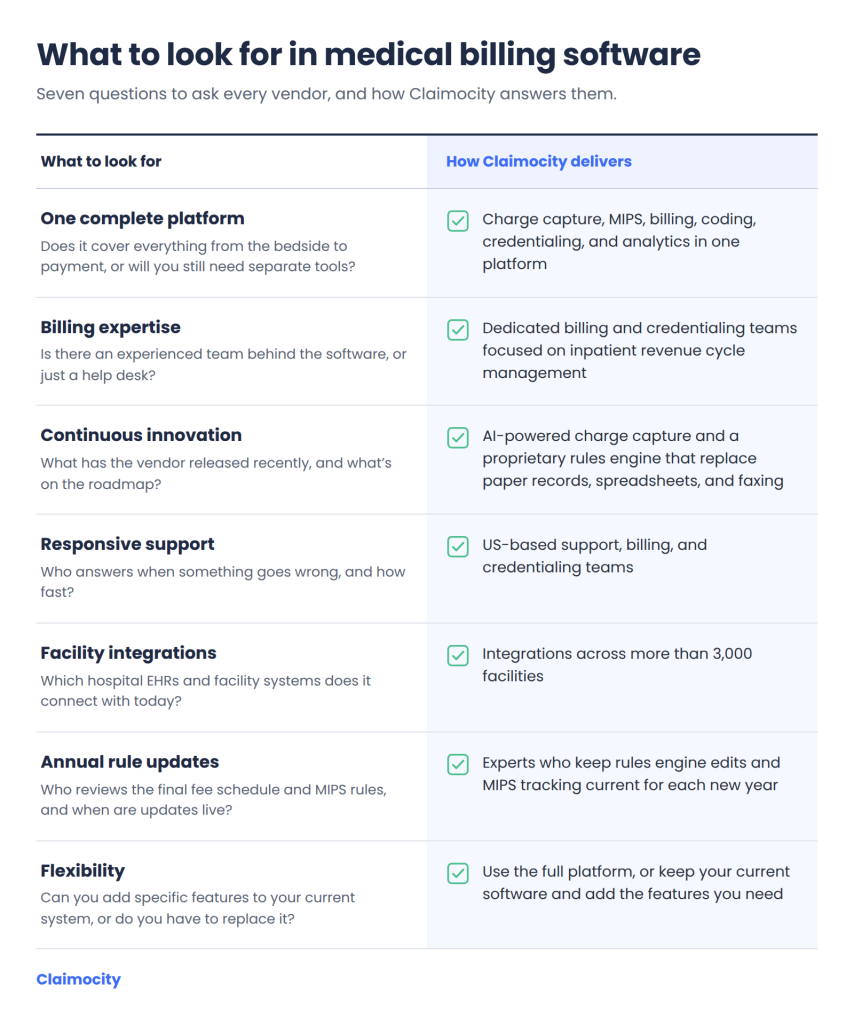
Ask every vendor to show you these answers in a live demo using real inpatient scenarios. A polished slide deck tells you very little about how the software handles a hospitalist with 20 patients across two facilities.
More Reasons to Choose Claimocity
Claimocity has spent more than 20 years focused on medical billing and revenue cycle management, and the platform is built specifically for inpatient providers. Rounding workflows are customized to how your providers see patients, whether they cover one facility or several.
That inpatient focus matters most when the rules change. As 2027 brings new fee schedule rates and MIPS requirements, our team keeps your rules and workflows current so your providers can stay focused on patient care.
Book a demo to see how Claimocity fits your practice.