

Blog Post
Bill Smarter: A Better Approach for Physician-Owned Multispecialty Groups
Learn how Claimocity uses ethical AI in healthcare with HIPAA compliance, coding rationale, and improved accuracy to protect patient data.
Claim denials are a persistent challenge in healthcare revenue cycle management (RCM). Across the industry, roughly 10-12% of claims are denied on the first submission. In post-acute care, however, the numbers can be much higher. Some Medicare Advantage insurers deny nearly one in four initial requests for services such as skilled nursing facility stays.
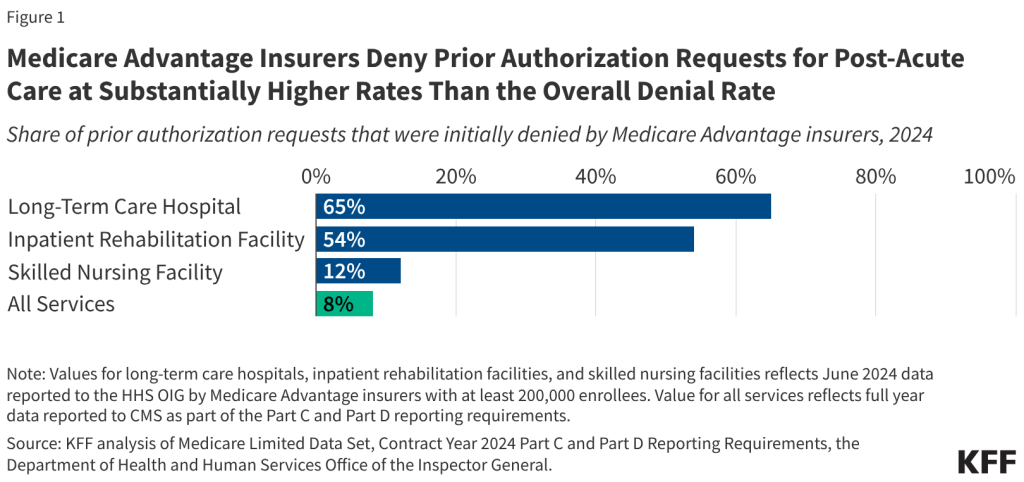
And this is on top of eye-popping rates of prior authorization denials for the post-acute care industry, published by the Kaiser Family Foundation.
Healthcare RCM is often thought of as the billing process. This is only partially accurate. RCM covers everything from patient pre-registration to follow-up and payment collection, and every step in between. For small clinics and facilities with a limited staff, the process can become impossible to manage efficiently.
For skilled nursing facilities, rehab centers, and home health care businesses, managing revenue cycle management presents a unique set of challenges. Large hospitals employ specialists to handle their revenue cycle operations and reduce days in accounts receivable. Smaller facilities lack the resources to effectively manage RCM. That’s where dedicated RCM software with AI capabilities enters the picture. For a fraction of the cost of hiring a team of RCM specialists, even small practices can accurately and efficiently handle their RCM needs.
There are several challenges that providers and administrators in post-acute care face when it comes to day-to-day revenue cycle management. The main issues are frequent claim denials, staffing shortages, and fragmented payer sources.
The top insurers deny post-acute claims much more often than other industry segments, citing reasons like lack of medical necessity, insufficient documentation, and authorization mismatches. Managed care plans tend to deny more aggressively than traditional Medicare, and appeals can eat up time and resources.
Post-acute RCM requires specialized billing knowledge, so training can be costly. It can take months for new staff to learn payer-specific rules. High turnover and burnout mean those training investments are often lost, making it difficult to keep up with follow-ups and backlogs.
Post-acute care businesses juggle payments from Medicare, Medicaid, Medicare Advantage, commercial payers, and payments from patients. Each type of payer operates under a different set of rules, documentation quirks, and timelines. Because of that, it can be difficult to predict budgets and chase down payments.
The issues with revenue cycle management are not new. For years, businesses have been working to find solutions to this complex aspect of the post-acute care industry.
Electronic Medical Records offer several distinct advantages over paper records. EMRs are more accurate and more secure than paper records. The data is clean and better-structured. Real-time documentation supports more complete claims. The issue with EMRs is that they are disconnected from RCM systems. This integration gap can result in missing charges and lost revenue.
Hiring an in-house team isn’t always feasible. Outsourcing RCM can give providers access to specialized billing expertise and dedicated resources without the expense of building a full internal team. Experienced RCM partners help manage claims processing and keep follow-ups moving so payments are not delayed. Outsourcing can be an effective way to improve efficiency and create a more predictable flow of revenue.
Automated RCM gets to work right away, improving your processes by catching missing documentation and coding gaps before claims go out. Automated charge capture never misses a charge, so you aren’t losing revenue due to integration gaps. And AI is a master of multitasking, so eligibility, authorizations, and follow-ups run in parallel. AI can also predict which claims are most likely to be denied, so your team can prioritize the highest-risk claims. The beauty of AI is that it’s constantly learning, so it can customize itself to work better and better with your particular business.
In post-acute settings, RCM challenges often force administrators into a constant game of catch-up. Manual RCM workflows create compounding delays when even small errors occur. Soon the entire process is in reactive mode, and that becomes a slippery slope as payments get further and further behind.
Modern, AI-powered software from Claimocity gets your RCM back on track and working proactively. Our mobile charge capture app is its own resource, especially for post-acute care rounds at multiple facilities.
Sound too good to be true? Check out this Claimocity case study in which an Internal Medicine group practice saved half an hour per day, while receiving an extra $20K/month in reimbursed claims. Here’s how we do it:
Claimocity analyzes signed EHR notes, identifies every billable interaction, and automatically populates charge lists.
Claimocity’s AI-driven software suggests relevant ICD-10 and CPT codes by analyzing patient diagnoses and procedures. Recommendations are aligned with CMS guidelines and include supporting rationale.
Automated RCM gets to work right away, improving your processes by catching missing documentation and coding gaps before claims go out. Automated charge capture never misses a charge, so you aren’t losing revenue due to integration gaps. And AI is a master of multitasking, so eligibility, authorizations, and follow-ups run in parallel. AI can also predict which claims are most likely to be denied, so your team can prioritize the highest-risk claims. The beauty of AI is that it’s constantly learning, so it can customize itself to work better and better with your particular business.
AI minimizes mistakes and ensures greater accuracy by automating the billing process. On the whole, AI can predict and prevent up to 85% of potential claim denials.
Your practice should be paid whenever a service is provided. Our AI-driven software helps you capture all billable services by identifying potential missed charges.
Not all software is created equal. How well it integrates with your current systems is a crucial consideration. Claimocity automated RCM software was developed with these considerations in mind. More than just a powerful tool to optimize revenue management, it was specifically designed to integrate painlessly with your practice.
Your automated RCM needs to connect easily to your current medical records and billing systems to prevent staff from having to input data manually, which makes mistakes more likely.
The platform should be easy for staff to learn and use without long, complicated training. Teams are already stretched thin, so new technology should make their jobs easier without adding more steps. Even so, taking the time to properly train staff during implementation is important. Claimocity helps make that process easier with a structured onboarding experience that helps to smooth the transition.
With the new platform in place, you should be able to easily see the improvements that are being made, like fewer denials and faster payments. Easy-to-read dashboards help teams see where problems still exist and where things are improving.
As reimbursements become more complex and margins tighten, AI-driven RCM that used to seem like a luxury has become a baseline requirement in post-acute care. In fact, a recent study showed that 98% of hospitals plan to use AI to manage their billing processes, and 65% are already using AI.
If you want your practice to remain financially stable and competitive, you need physician billing software that’s designed for the nuances of post-acute care and inpatient facilities.
Providers that adopt automated RCM are seeing immediate results: faster reimbursements, lower denial rates, and increased efficiency without making huge investments in staffing.
Claimocity is leading the AI-driven charge. The platform is designed to streamline revenue cycle management from patient registration to final payment collection. The software uses natural language processing (NLP) and machine learning to improve the revenue stream and reduce the time your team spends on repetitive tasks.
Our automated RCM software lets your business adapt to the changing post-acute environment without rebuilding your processes, so you can quickly move toward faster, more predictable revenue operations, all with the same team.
Are you ready to take your post-acute practice to the next level with improved cash flow and reduced staff burnout? AI-driven RCM solutions give your post-acute team the tools they need to take back the time spent on repetitive administrative tasks.
Schedule a demo to learn how Claimocity helps post-acute providers modernize workflows and realize the operational and financial benefits of AI-driven automated RCM software.
Learn how Claimocity uses ethical AI in healthcare with HIPAA compliance, coding rationale, and improved accuracy to protect patient data.

Identify and stop revenue leakage with expert tips and prevention strategies from Claimocity.

Discover how claims scrubbing in medical billing maximizes your revenue by minimizing denials and speeding up reimbursements effectively.