
Claimocity Claims
Inpatient CPT Codes: A Guide to Hospital Billing Codes by Service and Specialty
Medical coding is hard enough for simple, outpatient procedures. Take those same procedures and perform them in a hospital on the same day that a patient’s admission status changes, and things get even more complicated. Whether you’re an interventional cardiologist who provides critical care on a regular basis or a rheumatologist who provides consultations for hospitalists, you need to know how CPT codes are used for your inpatient care services.
Use this CPT code guide to understand the complexity involved in creating clean medical claims. It also includes a preview for CPT code changes slated for 2027.
Complete List and Billing Cheat Sheet for Inpatient CPT Codes
There is no such thing as a complete list of inpatient CPT codes because not all the codes are inherently “inpatient” or “outpatient.” That said, there are E/M Codes that are frequently part of medical claims for services performed in an inpatient setting. To help providers and billing specialists reference these codes, Claimocity created this inpatient billing cheat sheet and 2026 Inpatient E/M Coding Calculator.
The complete list of CPT codes for 2026 contains 11,520 codes and is compiled in the AMA’s CPT® 2026 Professional Edition. The CMS 2026 NCCI Coding Policy Manual continues to categorize the AMA CPT codes into E/M, critical care, procedures, and NCCI edits, further demonstrating there isn’t a single, master list of inpatient codes.
Inpatient CPT Code Families
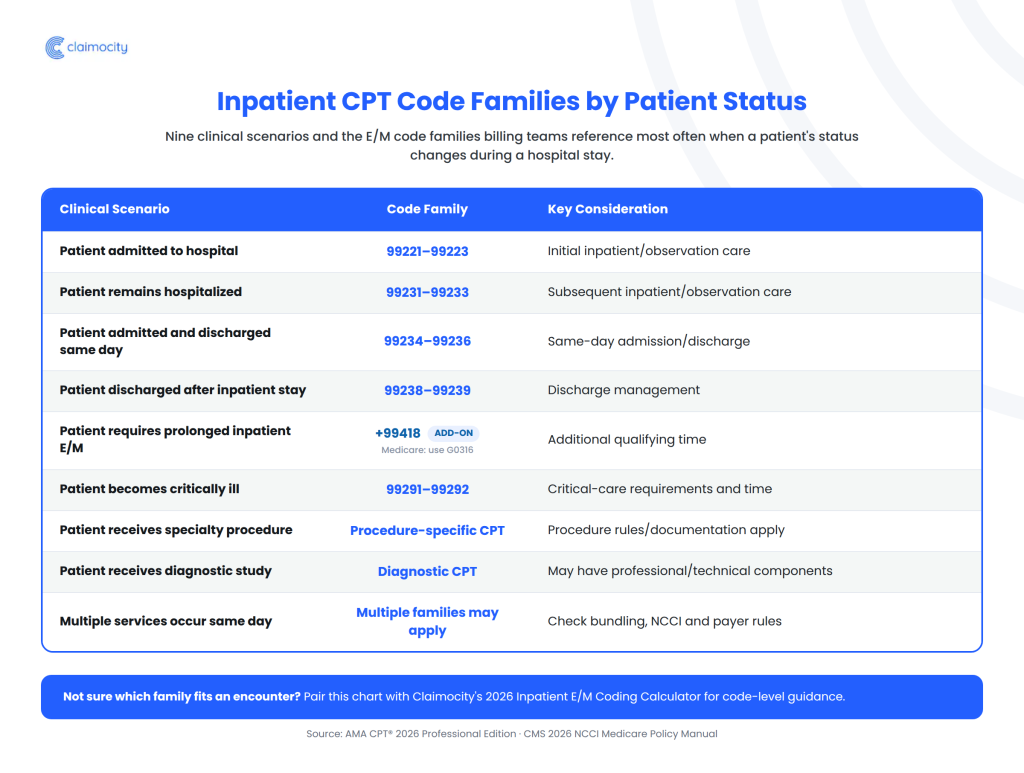
Between a simple cheat sheet and a comprehensive list of 11,000+ codes, there are complementary resources and a few different ways of categorizing medical codes that are helpful for providers and billing specialists to know. Let’s start with common inpatient codes based on the clinical scenario and patient status.
Same Codes, Different Procedures by Specialty
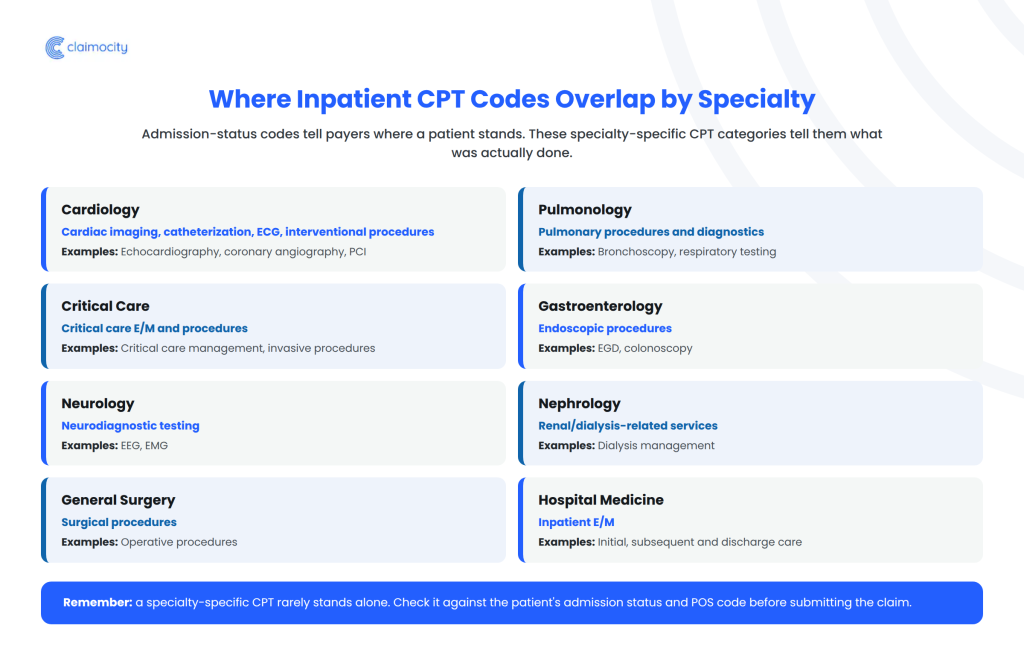
Inpatient CPT codes mostly indicate the patient’s admission status and scope of care, while other CPT codes capture the particular specialty or service. Some care services have setting restrictions, so they can only be billed and approved when performed in the appropriate setting.
The Centers for Medicare & Medicaid Services even maintain a discrete list of inpatient-only (IPO) services. However, this IPO list is being phased out over the next three years, starting with 285 mostly musculoskeletal procedures, as they become more medically accepted as outpatient procedures.
Here are the most common specialty care services and procedures that are captured alongside inpatient CPT codes.
Different Types of Medical Coding: HCPCS vs CPT vs ICD vs POS Codes
- HCPCS (Healthcare Common Procedure Coding System) is a broader system that includes CPT as its Level I set as well as Level II alphanumeric codes for medical equipment, ambulance transport, certain drugs, and other non-physician services.
- CPT (Current Procedural Terminology) describes the specific procedures and services a provider performs things like an office visit, a surgical procedure, or a diagnostic test. Learn more about how to use HCPCS vs CPT codes when submitting claims.
- ICD-10 (International Classification of Diseases) describes the diagnosis or condition that justified the care. But for inpatient stays specifically, there’s ICD-10-PCS, a separate procedure coding system used only in the inpatient hospital setting.
- POS (Place of Service) is a system of two-digit codes that indicates where the service happened, office, inpatient hospital, outpatient hospital, and so on. They matter because the same CPT code can be reimbursed differently depending on the setting.
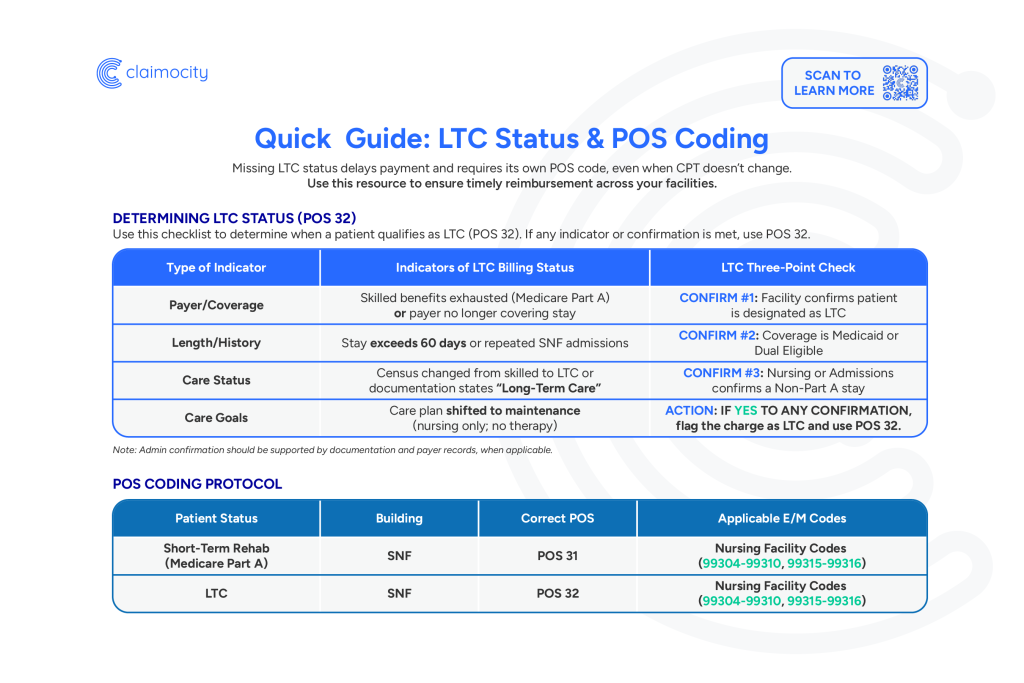
This cheat sheet is far from a comprehensive guide, especially when it comes to POS coding. There are currently 52 active Place of Service (POS) codes maintained by the Centers for Medicare & Medicaid Services (CMS) for medical billing and claims. In theory, you can even provide inpatient care services with a telehealth POS 2 code, if you’re providing a remote consultation for a patient who’s in a rehab facility.
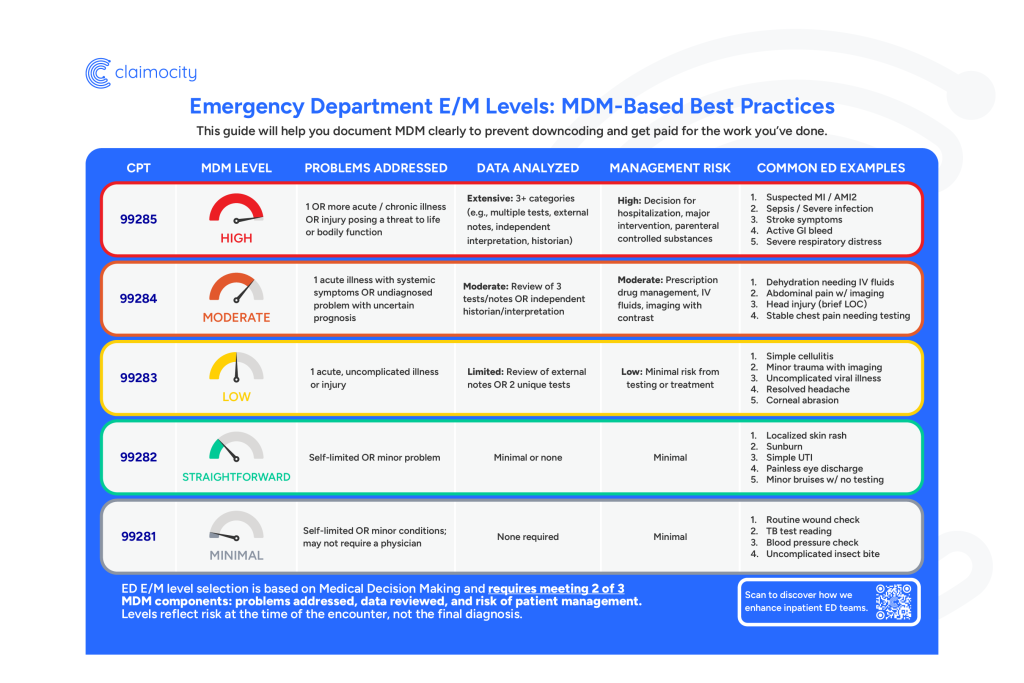
While inaccurate POS coding is a common source of claim denials especially for LTC billing, medical decision-making codes are crucial to ensure providers receive full reimbursement for services. While these codes apply to Emergency Department Services, they’re not technically considered inpatient CPT codes because they don’t depend on the patient’s admission status.
Get to Know the 2027 CPT Code Changes
They’re not finalized and they’re not effective till Jan 1, 2027, but the AMA recently issued their proposed changes to the CPT® Professional Edition for next year. The new edition includes 453 editorial changes: 299 new codes, 74 revisions, and 80 deletions, bringing the full code set to over 11,740 codes. In particular, we noticed the three new codes for left ventricular assist device implantation, as these procedures take place in hospitals often with ICU-level care. You can buy the full booklet of 2027 changes on Amazon.
Medical Billing Software and Support Services from Claimocity
Our advanced charge capture and claim auditing software is already a huge resource for automated medical billing processes. We also offer end-to-end revenue cycle management services with comprehensive audits and optimization insights.
Don’t let the fear of onboarding a new medical billing solution stand in your way. Most new Claimocity clients see an immediate jump in monthly revenue and often a sizable chunk of recovered payments from your current revenue cycle backlog.
Get a Live Demo to see our platform in action and get to know our sales and support teams.
FAQs
What are the 5 common CPT Code categories used for inpatient care settings?
There are initial inpatient services (99221-99223), subsequent inpatient services (99231-99233), inpatient services provided the same day as admission or discharge (99234-99236), discharge services (99238-99239), and the prolonged time add-on code (99418 or G0316). You can find more details about these codes in our 2026 Inpatient E/M Coding Calculator.
Is 99232 an inpatient or outpatient code?
CPT code 99232 can be either. It falls under the combined code family “Subsequent Hospital Inpatient or Observation Care,” which covers a follow-up visit of moderate complexity for a patient who is already in the hospital. What determines whether the encounter is billed as inpatient or outpatient is the POS code attached to the claim. POS 21 (Inpatient Hospital) applies when the patient has been formally admitted, while POS 22 (On Campus-Outpatient Hospital) applies when the patient is under observation status.
What is the difference between code 99223 and 99255?
99223 and 99255 both describe high-complexity hospital visits, but for different roles. 99223 is the top level of Initial Hospital Inpatient or Observation Care, billed by the admitting physician. 99255 is the top level of Inpatient or Observation Consultation, for consulting physicians. In practice, however, many providers bill 99223 even when consulting, since Medicare and most other payers have stopped reimbursing consultation codes.
Are there other CPT codes that aren’t accepted by Medicare and insurance payers?
Yes, there are several prominent examples of this in medical billing. Medicare and CMS no longer recognize the prolonged time code 99418 but do allow the HCPCS Code G0316. Unlike Code 99255, many private insurers still accept Code 99418 for prolonged time. These discrepancies occur because the AMA maintains and publishes the CPT code book, but CMS decides what Medicare will actually pay for. Private insurers will often, but not always, follow what CMS does.
Related Posts

Inpatient CPT Codes: A Guide to Hospital Billing Codes by Service and Specialty
From cardiologists who provide critical care to rheumatology consultations, know how CPT codes are used for inpatient care in 2026 and 2027.

AI Billing, Upcoding, and the True Cost of Hospital Care
A BCBSA study shows AI hospital billing is increasing provider reimbursement rates. Claimocity has long known this. Learn what it means for hospital care.

ACA Claim Denial Rates: What’s Behind the Numbers
Getting multiple claim denials from patients with ACA insurance plans? It’s not just you. These plans are known for higher denial rates.