Claimocity Claims
What's Changing in MIPS for 2027?
Your Complete Guide

Another year, another round of Medicare regulation updates. This one sets up the biggest shift in MIPS since the program launched. The CMS Physician Fee Schedule Final Rule for 2027 changes how you earn your points. It changes how you choose Quality measures, while trimming several Promoting Interoperability requirements.
It also sets an end date for traditional MIPS reporting, which wraps up after the 2030 performance year. Hospitalists have their own news this year, too. CMS finalized the first MIPS Value Pathway built around hospital medicine.
The performance year runs all of 2027, so any changes to your measure selection, documentation, or workflows should happen before January. Wait until mid-year to sort this out, and you’ll spend the rest of the year playing catch-up. This guide breaks down the 2027 MIPS updates by category, explains what they mean for your practice, and gives you a clear plan to get ready.
MIPS Basics: What You Need to Know
MIPS is Medicare’s performance-based payment system that adjusts your Medicare Part B payments based on how well you meet specific quality, cost, and technology benchmarks. Think of it as Medicare’s report card for your practice. Your score determines whether you receive a positive adjustment, a penalty, or no change.
The program measures performance across four categories:
- Quality: How well you meet clinical care standards (30% of your score)
- Cost: Your efficiency in delivering care relative to episode-based benchmarks (30% of your score)
- Promoting Interoperability: Your use of certified EHR technology to improve care coordination (25% of your score)
- Improvement Activities: Your participation in care improvement initiatives (15% of your score)
CMS updates the requirements every year to reflect evolving healthcare priorities. For how eligibility, scoring, and reporting work in any year, see our complete guide to MIPS reporting.
The New Hospitalist MVP
For the first time, hospitalists have a MIPS Value Pathway built for their specialty. CMS finalized a Hospitalist MVP for the 2027 performance year, along with new MVPs for diabetic disease and hypertension.
An MVP is a preset bundle of quality measures, cost measures, and improvement activities. You report four Quality measures and one Improvement Activity from the MVP’s lists, so you aren’t building your own set from the full inventory. Like every MVP, it includes MIPS core measures. Check the final measure list on the QPP site before you decide whether to register.
MVPs are optional in 2027. That matters, because CMS finalized making them the only way most clinicians can report MIPS starting with the 2031 performance year. That gives hospitalist groups four years to try the pathway before it’s required.
The Bigger Picture: A Deeper Medicare Rate Cut
MIPS adjustments are a percentage of what Medicare pays you, and the CY 2027 final rule lowers that base. The physician conversion factor drops to $32.63 for 2027, down 2.31% from $33.40 in 2026. That’s deeper than the 1.68% cut CMS proposed in July. The main reason is that a one-time 2.5% increase for 2026 expires. Clinicians with Qualifying APM Participant status get a slightly higher conversion factor of $32.95, down 1.83%.
Hospitalists take a slightly bigger hit than the conversion factor alone. Work RVUs for core inpatient codes don’t change, but practice expense and malpractice RVUs dip slightly on nearly every one. Here’s how the national facility rates compare:
| CPT code | Service | 2026 | 2027 | Change |
|---|---|---|---|---|
| 99221 | Initial hospital care, straightforward or low complexity | $74.48 | $72.11 | -3.2% |
| 99222 | Initial hospital care, moderate complexity | $116.90 | $113.55 | -2.9% |
| 99223 | Initial hospital care, high complexity | $156.31 | $150.75 | -3.6% |
| 99231 | Subsequent hospital care, straightforward or low complexity | $44.09 | $43.07 | -2.3% |
| 99232 | Subsequent hospital care, moderate complexity | $70.47 | $68.20 | -3.2% |
| 99233 | Subsequent hospital care, high complexity | $106.88 | $102.78 | -3.8% |
| 99238 | Hospital discharge, 30 minutes or less | $74.82 | $71.79 | -4.0% |
| 99239 | Hospital discharge, more than 30 minutes | $106.55 | $102.13 | -4.1% |
| 99291 | Critical care, first 30 to 74 minutes | $199.06 | $192.84 | -3.1% |
| 99292 | Critical care, each additional 30 minutes | $100.20 | $97.56 | -2.6% |
Same-day admission and discharge codes (99234 to 99236) drop 3.0% to 3.8%. These are national rates before geographic adjustment, MIPS adjustments, and sequestration.
For a hospitalist group billing $1 million a year to Medicare, that’s roughly $23,000 to $41,000 less for the same work in 2027, depending on code mix. Any MIPS adjustment comes on top of that. A penalty deepens the cut. A positive adjustment, which CMS projects will top out around 1.34% for the 2027 performance year, offsets only part of it.
More 2027 Changes: What's New in Each Category
The performance threshold stays at 75 points, where CMS has locked it through the 2028 performance year. Below 75, Medicare cuts your Part B payments on a sliding scale, from 0% at 75 points to a maximum 9% cut at 18.75 points or below. Above 75, every point earns a positive adjustment, but those adjustments are funded by penalties and stay small.
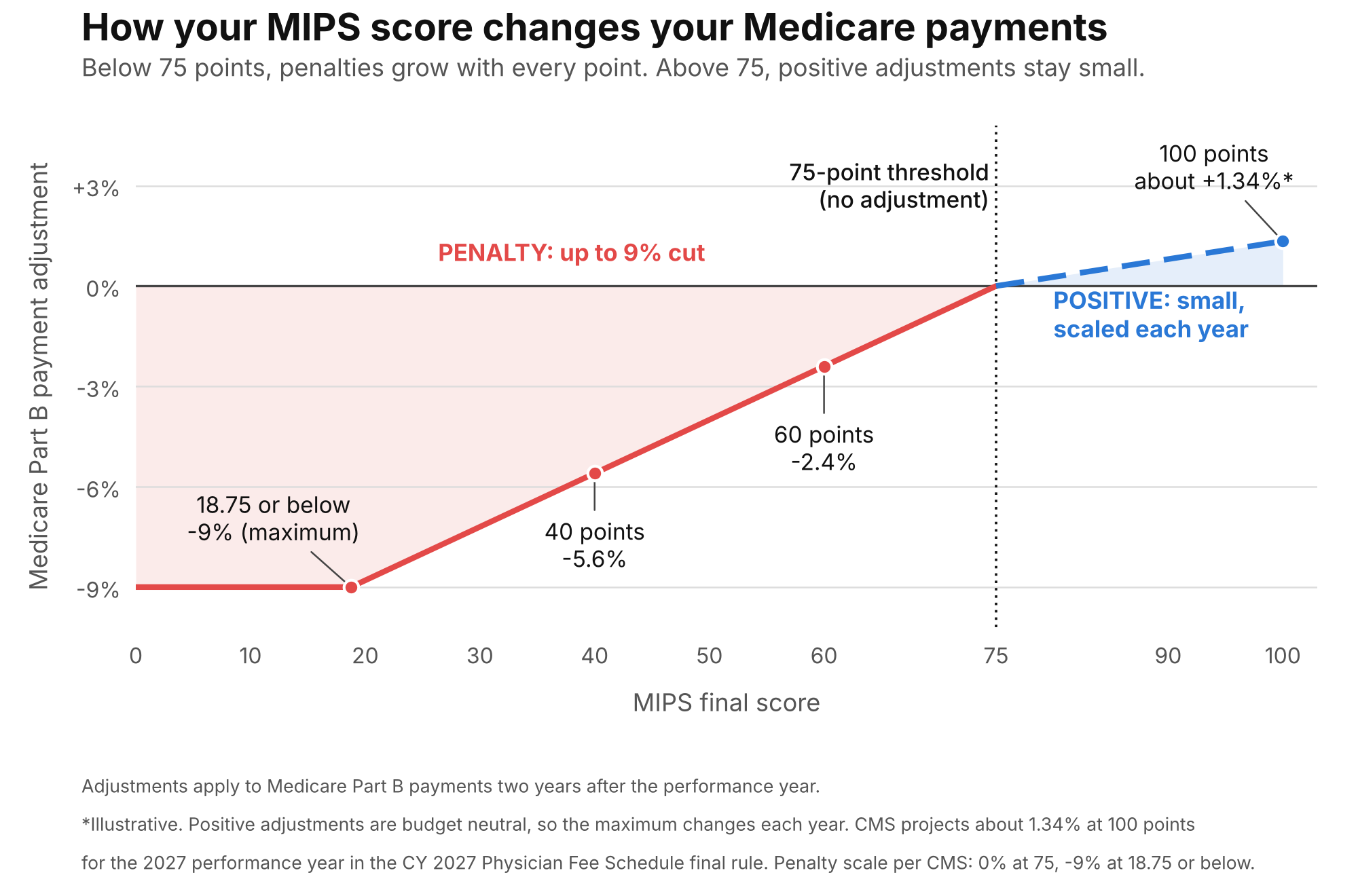
CMS’s own projections show how small. For the 2027 performance year, it estimates a median final score of about 89 and a maximum positive adjustment of about 1.34%, with about 7.6% of clinicians receiving a penalty. For what that means for your target, see what counts as a good MIPS score.
Quality: Core Measures Replace the Outcome Requirement
The biggest Quality change is a new MIPS core measure requirement. Today, one of your six measures has to be an outcome measure, or a high-priority measure if no outcome measure applies. Starting in 2027, CMS is replacing that rule with a requirement to report at least one core measure.
- Core measures are a curated list of existing measures, with at least three in every MVP.
- If none applies to you, you attest to that during submission and report another measure in its place.
- Skip the core measure without attesting, and one of your required measures scores zero.
- Practices with 15 or fewer clinicians are exempt from the requirement.
- Core measures that have been topped out for two or more consecutive years aren’t held to the 7-point cap, so they can still earn the full 10 points.
CMS also removed the high-priority measure designation. The measure inventory shrinks to 180, with 20 measures removed, 10 added, and 43 changed. Check every measure you reported in 2026 against the final list. Our guide to MIPS Quality measures covers how to choose.
Cost: No New Measures
CMS didn’t add any new cost measures for 2027. The only update is its annual refresh of the codes that define care episodes. Cost is still 30% of your score, so keep using your feedback reports to find high-cost episodes. See how MIPS scoring works for how Cost is calculated.
Improvement Activities: Same Scoring, Different Inventory
Scoring doesn’t change. You still need two activities for full credit, or one if you’re a small, rural, HPSA, or non-patient-facing clinician or an MVP reporter. The inventory does change. CMS is adding six activities, modifying five, and removing 11, which shrinks it from 95 activities to 90.
Inpatient groups should pay close attention to the removals. CMS cut several care transition and family engagement activities as duplicates, including care transition documentation, care transition operational improvements, and engaging patients and families in developing a plan of care. If your group reported any of these in 2026, plan a replacement before January. Our MIPS Improvement Activities guide lists activities that fit hospital medicine.
Promoting Interoperability: Fewer All-or-Nothing Requirements
PI has more changes than any other category.
- For 2026 data, submitted in early 2027: The ONC Direct Review attestation and the optional ONC-ACB Surveillance attestation are removed.
- For 2027: The Security Risk Analysis measure is removed, taking away one of the attestations that can zero out the category. Electronic prior authorization becomes an optional measure worth 10 bonus points.
- For 2028: Electronic prior authorization becomes required, along with a new attestation for electronic prior authorization of prescription drugs.
Hospital-based clinicians still have PI reweighted to 0% automatically. See Promoting Interoperability reporting and scoring for who has to report.
MVPs: Three New Pathways and Core Measures Built In
Beyond the Hospitalist MVP, CMS finalized MVPs for diabetic disease and hypertension, bringing the total to 30. It also updated existing MVPs and added core measures to all of them. MVP reporters make one of their four Quality measures a core measure from their chosen MVP.
Eligibility: No Changes
The final rule doesn’t change the low-volume threshold or who counts as an eligible clinician. If you were required to report in 2026, check your status again for 2027 using the steps in our MIPS eligibility guide. This guide will also show you what’s changing in 2027 about how eligible clinicians report.
Looking Ahead: MVP-Only Reporting in 2031
CMS finalized ending traditional MIPS after the 2030 performance year, two years later than it originally proposed. Starting in 2031, clinicians who don’t report through the APM Performance Pathway will report through an MVP. CMS says about 98% of MIPS eligible clinicians already have an MVP that fits their specialty, and it’s working on options for subspecialists who don’t. Virtual groups will be able to report MVPs starting in 2029.
That makes 2027 through 2030 practice years. Report through an MVP while you can still fall back on traditional MIPS, and you’ll find your gaps before the switch is required.
Mark Your Calendar: Key MIPS Dates for 2027
| Date | What happens |
|---|---|
| January 1 to December 31, 2027 | Performance period. Quality and Cost cover the full year. |
| Any 90 consecutive days in 2027 | Minimum period for each Improvement Activity |
| Any 180 consecutive days in 2027 | Minimum period for Promoting Interoperability |
| During 2027 | MVP registration, if you report through an MVP. CMS announces the registration window each year. |
| Early 2028 | Submission window. It typically closes March 31, and CMS confirms exact dates on the QPP site. |
| January 1, 2029 | Your payment adjustment takes effect on Medicare Part B claims |
Quarterly checkpoints to keep yourself on track:
- Q1: Finalize which measures you’re reporting, including your core measure, and confirm your submission method.
- Q2: Run a mid-year performance check. Pull reports on your selected measures and look for documentation gaps.
- Q3: Start preparing your submission data, and resolve documentation problems while you still have time to improve.
- Q4: Complete final data validation before the performance period closes.
Prepare Your Practice: Action Steps for 2027
- Assess where you stand. Pull your most recent MIPS feedback report and compare your score to the 75-point threshold. If you lost points, find out whether measure selection, documentation, or data capture caused it.
- Check your measures against the core measure list. If none of your current measures is a core measure, pick one that fits your patients, or confirm you’ll need to attest that none applies. Small practices can skip this step.
- Replace any removed Improvement Activities. If your group reported a care transition or family engagement activity that’s being removed, choose a replacement before January.
- Confirm whether PI applies to you. Check the QPP Participation Status Tool for hospital-based status. If PI applies, make sure your team knows the Security Risk Analysis measure is going away, and decide whether to report electronic prior authorization for bonus points.
- Decide whether to try an MVP. If you’re a hospitalist group, look at the Hospitalist MVP’s measures against your current performance. You may not want to wait till 2031 to make the switch.
- Confirm your registry is ready. Registries will need to support core measures, and new MVPs within a year of being finalized.
Staying Ahead in the MIPS Landscape
MIPS compliance isn’t something you figure out once and forget about. CMS updates the program every year, and the next few years will bring bigger changes than usual as MIPS moves toward MVP-only reporting in 2031. What works for 2027 won’t necessarily work for 2031.
The practices that perform well on MIPS build compliance into their routine workflows rather than treating it as a separate project. They track performance in real time, catch documentation gaps early, and adjust their approach when something isn’t working.
Claimocity’s platform integrates MIPS tracking directly into your charge capture workflow, so monitoring compliance becomes part of your daily operation. Our system stays current with regulatory updates, tracks your performance across all four categories, and alerts you to potential issues before they impact your score. When submission time comes, our registry partner, Patient360, submits your data to CMS so you can focus on running your practice.
Ready to Simplify Your MIPS Compliance?
MIPS rewards consistency, not last-minute effort. Claimocity’s MIPS tools keep your performance on track all year, with updates and insights that surface when you need them.
Meet your 2027 MIPS requirements without adding hours of admin.
Sources
- CY 2027 Physician Fee Schedule final rule, CMS-1848-F, 91 FR 70992 (November 9, 2026): conversion factor, core measures, high-priority designation removal, Quality inventory counts, IA changes (91 FR 71545 to 71548), PI changes, new MVPs, MVP-only reporting starting in 2031, eligibility, regulatory impact analysis (91 FR 71671 to 71677)
- CMS press release: CMS Finalizes CY 2027 Physician Fee Schedule
- CMS Physician Fee Schedule Addendum B for CY 2026 and CY 2027: RVUs used for the hospitalist payment table (national facility rates)
- 42 CFR 414.1405: performance threshold and payment adjustment scale